

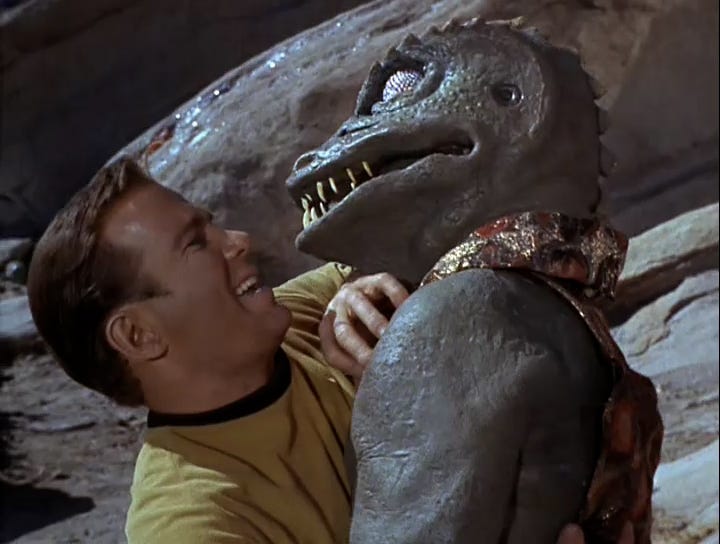
Kirk and the Gorn captain on their first date.
“The Survivor is the Champion of His Race”
Gene Coon joined the Star Trek production team on August 8, 1966. His on-screen title was producer (Gene Roddenberry was executive producer), but his responsibility was to run roughshod on the free-lance writers Roddenberry had recruited to write the first season’s scripts.
As we’ve discussed in earlier columns, the free-lancers generally fell into two categories — science fiction literary writers with little to no television experience, and experienced TV writers with little to no science fiction experience.
Coon was no novice either. He’d been writing TV scripts since the mid-1950s. He didn’t have much science fiction experience, but his last job had been as a producer on the fantastical series The Wild Wild West. So not only was he supervising and editing the writers, but he also began to write his own scripts.
Marc Cushman’s These Are The Voyages: Season One dates Coon’s earliest draft to early October 1966, a story outline for a script titled “Arena.” Known for his productivity, Coon wrote the outline while polishing the script for “The Menagerie” and running the show while Roddenberry was on vacation. NBC overseer Stan Robertson praised the premise, calling it “one of the really superior Star Trek story outlines we have received to date.”1
The story had one problem — someone else had already written it.
Fredric Brown began his literary career writing detective novels, but by the 1940s had branched into science fiction. Brown won the Edgar Award in 1948 for his first mystery novel, The Fabulous Clipjoint.
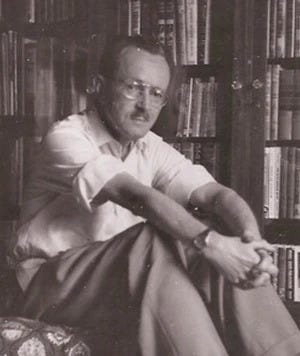
Author Fredric Brown, unknown date. Image source: MUBI.
“Arena” was first published in the June 1944 issue of Astounding Science Fiction. The premise is very similar to what we know from Star Trek. Two spacefaring fleets are about to annihilate one another, when an advanced alien species intervenes. A representative is chosen from each of the two fleets to fight it out on an alien world. The loser’s fleet and race will be destroyed.
The alien race in the original is not the Gorn. They’re not even reptilian. They’re known only as the Outsiders. The protagonist, a pilot named Carson, has no idea what an Outsider looked like until he’s whisked away to challenge his opponent.
The publication had illustrations, drawn by someone named Williams, that gave us an idea of what an Outsider looks like. In one illustration, the Outsider is torturing a lizard (not a Gorn).
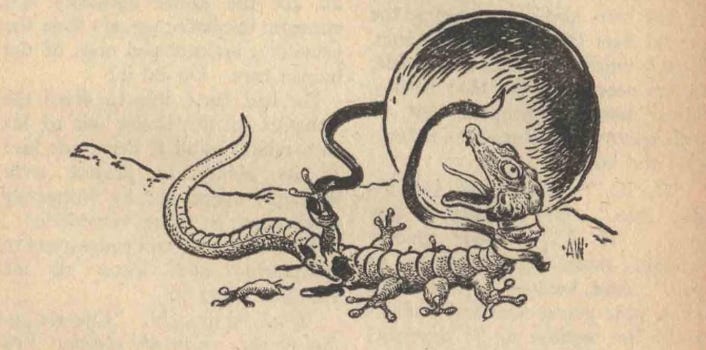
“Roller” as it appeared in the June 1944 issue of “Astounding Science Fiction.” Image source: Internet Archive.
The prose provides a more detailed description. The Outsider is called a “Roller” by Carson. Here’s how the text describes Roller:
It seemed to have no legs or arms that he could see, no features. It rolled across the blue sand with the fluid quickness of a drop of mercury. And before it, in some manner he could not understand, came a paralyzing wave of nauseating, retching, horrid hatred.
Coon’s draft went off to Kellam deForest Research, a company that did script clearance for Hollywood studios. deForest might be asked by Gunsmoke writers, “Could an Indian testify at a court trial in Kansas in 1875?” For Star Trek, deForest wrote a seven-page analysis explaining why a planet can’t have no variations in surface temperature. They also reviewed scripts for any legal traps, such as plagiarism (inadvertent or otherwise) of previously published or produced materials.2
A deForest staffer immediately recognized Coon’s “Arena” as a wholesale lift of Brown’s “Arena.”
Oops.
In his memoir, Inside Star Trek: The Real Story (co-written with Bob Justman), Desilu executive Herb Solow wrote:3
Coon, an ardent reader of science fiction since he was a child, in his haste to create a story, had inadvertently based part of his script on a short story that had been written by Fredric Brown.
Desilu’s legal department contact Brown’s agent. Brown was unaware a script had already been written. He was sent the final draft script for approval. At age 60, Brown took the deal, which included a “story by” screen credit.
In 1972, Roddenberry exchanged letters with science fiction author Harry Stubbs, who wrote under the alias Hal Clement. In one letter, Roddenberry commented:4
Incidentally, we did take “Arena” from Frederik Brown’s story and paid him accordingly … We had a rather enviable record, which I wish someone would mention sometime, in that Star Trek was never sued for plagiarism in any form and I have always been rather proud of that (although I am knocking wood at this very moment).
That latter claim isn’t quite true. As mentioned in our last column about “The Squire of Gothos” writer Paul Schneider later filed a grievance with the Writers Guild of America alleging that the second season episode “Patterns of Force” was based on his rejected script “Tomorrow the Universe.” The WGA found in favor of Roddenberry.
“Why Did They Do It? There Has to Be a Reason”
An Enterprise landing party led by Captain Kirk is about to beam down to an “Earth observation outpost” on Cestus III, at the invitation of one Commodore Travers. The commodore specifically requests that Kirk bring his tactical people. “I’ve got an interesting problem for them.” Spock questions why Travers is so insistent that the tactical aides beam down.
We get a little of the Spock-McCoy banter that Gene Coon has been sprinkling into the scripts:
Spock: “Doctor, you are a sensualist.”
McCoy: “You bet your pointed ears I am.”
The landing party beams down to find the outpost has been destroyed. There’s a redshirt among the group, which is our first clue that this won’t go well.
“Arena” was the second episode filmed off a studio lot, the first being “Shore Leave.” As they gained experience, the show’s producers became more comfortable with filming on location.
The outpost is actually a fort set built for the 1956-1957 NBC TV series, Tales of the 77th Bengal Lancers. Fort Oghora was located at Vasquez Rocks in Santa Clarita, California. Covering three and a half acres, the fort set cost Screen Gems $118,000 in 1956 dollars. According to one report, the fort was demolished by the County of Los Angeles in the early 1970s, before Blazing Saddles filmed on the location. Although Vasquez Rocks has been used in many films and television shows over the decades, arguably it’s most famous for its Star Trek episodes, starting with “Arena.”
In this episode of “Tales of the 77th Bengal Lancers,” you can see Fort Oghora, which was located at Vasquez Rocks. Video source: Finbar Tilderhaven YouTube channel.
Whomever sent the message from “Commodore Travers” several days ago was clever enough to fake his voice, for the purpose of luring them here. A trap has been laid to kill the tactical officers, as well as Kirk and the rest of his command staff. Spock’s tricorder detects cold-blooded non-human life forms in the hills nearby.
Our redshirt, Ensign O’Herlihy, is the first to die, disintegrated by some sort of weapon fired from the hills. For the record, he’s crew member death #11 to date in the series, but not the first redshirt. The first two redshirts to die were security officers Matthews and Rayburn in “What Are Little Girls Made Of?”
Kirk calls the bridge requesting beam-out, but Sulu has raised shields as the Enterprise comes under attack from an alien ship. The landing party is bombarded by a weapon that Spock calls “disruptors.” Both William Shatner and Leonard Nimoy suffered ear damage from the explosives set off filming these scenes, resulting in lifelong tinnitus.
With phasers and photon torpedoes ineffective against the enemy ship, Sulu makes the command decision to warp out of orbit — a decision Kirk supports. The ship’s survival is, um, paramount. (Although it was still Desilu at this time.)
The enemy’s technology is so superior that they lock onto Spock’s tricorder, which explodes after he tosses it away. Communications are jammed as well. Kirk reaches the outpost arsenal and finds a grenade launcher. Crewman Lang joins the casualty list off-screen, becoming series fatality #12. Kirk fires off a mortar round, which uses the same sound effect as the Martian ships in the 1953 Paramount film War of the Worlds, and hits the enemy hideout. Not wearing a redshirt, crewman Kelowitz survives.
The alien ship withdraws, so Sulu contacts Kirk and the landing party members beam up. Kirk orders “thirty medical personnel” to beam down to look for survivors. Since the crew complement is about 430, that’s a lot more medical staff than we’ll ever see on screen. McCoy, however, remains aboard as the Enterprise warps out to pursue the enemy.
Lieutenant Harold, rescued from the ruins, tells Kirk that Cestus III sent no messages to the Enterprise. The enemy ship was invited to visit, then attacked. The enemy refused to accept surrender. There seemed to be no motive for the attack. “Why did they do it? There has to be a reason!”
Spock tries to get Kirk to consider the reason, but Kirk has already made up his mind — the motive is invasion. Kirk orders the ship to battle stations, but Spock clearly thinks this is premature.
An “unidentifiable power” (in Spock’s words) from an uncharted solar system brings the Enterprise and the alien ship to a stop. The engines won’t work, and neither do the weapons. An audio-only transmission is received from a race called the Metrons. (If the voice sounds familiar, it belongs to Vic Perrin, who narrated the opening credits of The Outer Limits.) Because both species have violated their space with warlike intent, the Metrons will resolve the matter by transporting the two captains to a neutral planet with enough mineral resources to create weapons. “There you will settle your dispute.” Each captain will be provided with a recording / translating device. The winner and his ship will be allowed to leave, while the loser’s ship will be destroyed.
Unlike the original Fredric Brown story, the Metrons don’t specifically require them to fight. The tools are there. But the voice never says the dispute must be resolved by violence.
Kirk disappears from his bridge. Uhura’s scream seems quite out of character, in my opinion. He manifests on Planet Vasquez Rocks where he encounters the reptilian Gorn.
There’s no reason to go blow-by-blow through the fight. You’ve all seen it many times. I’m always perplexed by how slowly the Gorn moves. Kirk easily could have outrun it. A pro wrestling match is choreographed better than this battle.
For William Shatner, this episode is another advance in his portrayal of Captain Kirk. The writers are starting to take advantage of his natural athleticism. Being outside, he has room to run. “Shore Leave” was the first episode to let him off the leash, but “Arena” arguably is the most physical episode for Shatner in the series’ history. Give him credit for selling a fight with a stuntman in a rubber lizard suit.
A behind the scenes featurette about the Gorn in Strange New Worlds. Video source: Star Trek YouTube channel.
In the prequel series Strange New Worlds, the crew of the Enterprise and Starfleet deal with the Gorn long before the events of “Arena.” It’s inexplicable that Spock, Uhura, and Scott apparently have no memory of the Gorn. The SNW episodes were entertaining but totally violated canon. It was nice to see Gorn that didn’t look like rubber suits and moved fast.
Jason Nesmith in a battle with a rock creature that’s a loose homage to “Arena.” Video source: Movieclips YouTube channel.
Kirk recalls that the Metron said the planet had natural resources he can use to fashion a weapon. This scene is parodied in Galaxy Quest when Jason Nesmith fights off a rock creature. Guy Fleegman suggests, “Can you form some sort of rudimentary lathe?”5 No lathe, but Kirk does manufacture a primitive cannon that fires diamonds to wound the Gorn.
Rather than execute the alien, Kirk spares him, having learned that the Cestus III outpost was built in Gorn space, intruding into their territory. The Metrons let both of them go, and suggest they might recontact our half-savage species in several thousand years. Too bad Star Trek: Discovery never pulled on that dangling plot thread.
The episode has some lexicon firsts. Kirk tells Spock that “the Enterprise is the only protection in this section of the Federation.” When on the planet, Kirk requests that whomever finds his recording “please get it to Starfleet Command.” These are the first uses of “Federation” and “Starfleet Command,” both terms apparently introduced by Gene Coon.
Shatner and the Gorn reunited in March 2013 to promote a Star Trek video game released by Bandai Namco. The CGI Gorn in the game was a definite improvement on the rubber suit.
William Shatner and the Gorn play a video game. Video source: Bandai Namco Entertainment America YouTube channel.
Marc Cushman, These Are The Voyages: Season One (San Diego: Jacobs/Brown Press, 2013), 447.
Gene Handsaker, Associated Press, “Kellam deForest Is Fact-Finder, TV Nit-Picker,” The News-Times, May 31, 1967, 35.
Herbert F. Solow and Robert H. Justman, Inside Star Trek: The Real Story (New York: Pocket Books, 1996), 206-207.
David Alexander, Star Trek Creator: The Authorized Biography of Gene Roddenberry (New York: ROC, 1994), 397.
In Star Trek V: The Final Frontier, Kirk was to fight a rock creature but the scenes were never completed due to schedule and budget constraints. I always viewed this scene as giving director William Shatner the rock creature fight he’d envisioned.