

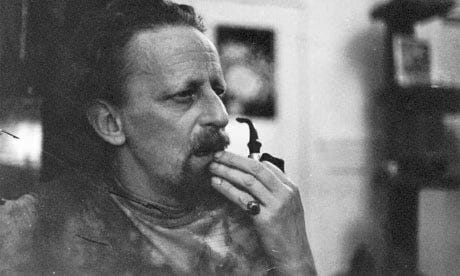
Science fiction author Theodore Sturgeon. Image source: The Guardian.
“Oh, My Paws and Whiskers! I'll Be Late.”
"… s f is indeed ninety-percent crud, but that also — Eureka! — ninety-percent of everything is crud." — Theodore Sturgeon.1
Gene Roddenberry’s original agreement with NBC was to provide thirteen episodes, as well as the second pilot and the first pilot repurposed into a two-episode event.
With that agreement fulfilled, Roddenberry took shore leave. He left production to Gene Coon and Bob Justman.
One of the scripts left behind was a draft written by Theodore Sturgeon, one of the “Golden Age” science fiction authors of the 1940s and 1950s. As we’ve discussed in earlier columns, Roddenberry had sought out free-lance writers that fell into two general categories — science fiction writers and veteran television writers.
Science fiction writers were used to novels, novellas, and short stories. Most of them struggled with the demands of episodic commercial television. Television writers struggled with understanding a TV show that had yet to air, which was creating its own fantastic universe on the fly.
By the time “The Menagerie” was submitted to Desilu and NBC, Roddenberry was exhausted. Left on his desk were scripts in development that remained unresolved.
One was “Shore Leave.”
In our earlier Substack column about the first pilot, “The Cage,” we discussed how Western novelist and screenwriter Samuel A. Peeples helped Roddenberry with his earliest research into the science fiction genre. Although known for his Westerns, Peeples was a science fiction enthusiast, and shared his collection with Roddenberry.
In his unauthorized biography, Gene Roddenberry: The Myth and the Man Behind Star Trek, Joel Engel wrote that Peeples suggested “eight notable sci-fi writers” to Roddenberry. Theodore Sturgeon was one of the eight.2
Marc Cushman in These Are The Voyages: TOS Season One wrote that “the basic idea” for “Shore Leave” came from Roddenberry’s March 1964 outline, “Star Trek Is …” which was written to pitch the series to studios and networks. In that outline, Roddenberry described a “parallel worlds” concept in which the starship (then called S.S. Yorktown) would visit Earth-like worlds that would be familiar to the viewer. It appears that “the basic idea” came from a story titled “The Man Trap,” which had nothing to do with the first season episode produced with that title. In this version, the crew visit a “pleasant totally earthlike and harmless” desert world. As they travel from one place to another, they begin to experience apparitions conjured from “whatever a man wants most.”3
As documented in earlier columns, during March 1966 Roddenberry invited potential writers to Desilu to view the second pilot, “Where No Man Has Gone Before.” Apparently Sturgeon attended one of these screenings.
According to Cushman, Sturgeon’s first story treatment was delivered on May 10. Because he had no experience with television scriptwriting formats, Sturgeon’s earliest submissions read more like short stories. As the revisions evolved, Sturgeon added copious notes and directions, which are inappropriate for televisions scripts; these are decisions a director makes, not the writer.
As with most of the scripts submitted by the science fiction writers, this one too was far beyond the show’s budget and production limitations. One example cited by Cushman is the theft of Doctor McCoy’s body by two mechanical arms that pop up out of a rock, bring him inside, and then the rock shuts.4
Sturgeon took offense to Roddenberry’s criticisms, in particular a description of the writing as “novelistic.” Cushman wrote that he believes Sturgeon had heard similar complaints from other SF writers unhappy with Roddenberry.
Producer Bob Justman was unhappy with the script as well. It was his job to watch the production costs. He complained about the Alice in Wonderland references. “If we attempt to put someone in a large rabbit suit, it will look like someone in a large rabbit suit.”5
Robert Sturgeon exited on September 9. Gene Coon had joined the staff August 8 as a producer. With a month of Star Trek experience, Coon took on the “Shore Leave” story. One change he made was to eliminate the Janice Rand character. As discussed in our “Miri” column, Grace Lee Whitney was sexually assaulted after filming on August 26, then her agent was notified a few days later that her contract would be allowed to expire. Rand was dropped from drafts of various scripts, including “The Galileo Seven” and “Court Martial.” Yeoman Tonia Barrows, who has a fling with McCoy in “Shore Leave,” is the residue of Rand from earlier drafts.
Roddenberry left for vacation in early October. He wrote a memo to Coon telling him that NBC’s Stan Robertson felt the story was still too fantastic, so revise the script to delete the white rabbit.
Except he forgot to give the memo to Coon.
Filming began on October 19. Roddenberry returned that morning and found to his horror the memo was still on his desk. The white rabbit scene was the first one filmed that day.
Roddenberry drove to the filming location at Africa USA in Soledad Canyon near Santa Clarita. Filming stopped while Roddenberry sat under a tree and scribbled script changes. His notes had to be taken back to the studio to be typed and then returned to the location.
This is one reason why so many scenes were lit with floodlights, so night could become day. Other scenes were shot for the first time at Vazquez Rocks, soon to become iconic for “Arena” and other Star Trek episodes.
The only prior episode to film on location was “Miri,” but that was on Desilu’s Culver City lot. This was the first episode to truly go off-site, and the bottom line reflected that. Budgeted at $185,000, “Shore Leave” cost $199,654 (an eight percent overrun), and finished a day late.6
“The Simplicity of Play”
The episode opens with the Enterprise in a clockwise orbit around a solid green planet. It’s one of the rare times that the starship orbits from east to west; the planet itself is rotating clockwise on its axis.
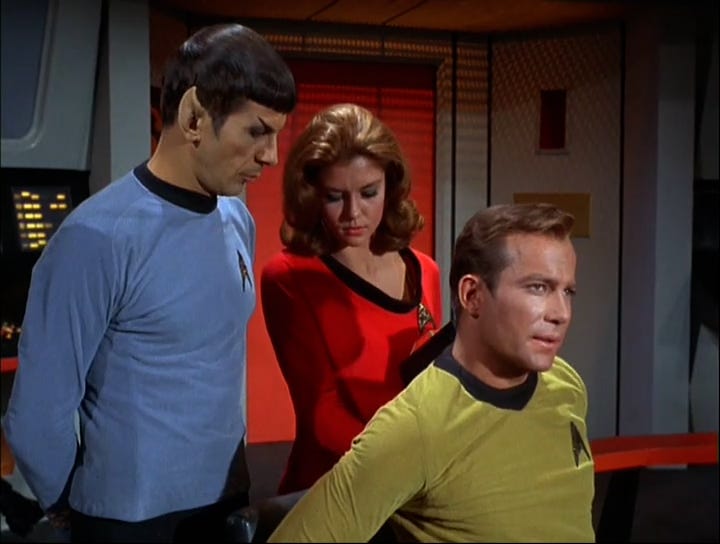
Spock observes Yeoman Barrows’ massage technique, perhaps for future reference.
Kirk complains about a kink in his back. Yeoman Barrows starts massaging the tensed muscle. “Push! Push hard!” Kirk pleads. He thinks it’s Spock. Well, okay … There’s long been a subgenre within Star Trek fandom known as K/S, or “K Slash S.” These are fanfic stories about a gay relationship between Kirk and Spock. You can find some at The Kirk/Spock Fanfiction Archive. (You are warned that they can be explicit in nature.) The University of California Riverside (my alma mater) maintains a collection of K/S stories.
Spock nags Kirk that, with the exception of himself, the captain and crew need rest. McCoy and Sulu are in a glade on the planet scouting its suitability for shore leave. Both have phasers, but only Sulu has a tricorder. (McCoy normally isn’t one for weaponry.) The botanist in Sulu starts collecting cell samples. Bones comments, “It’s like something out of Alice in Wonderland.”
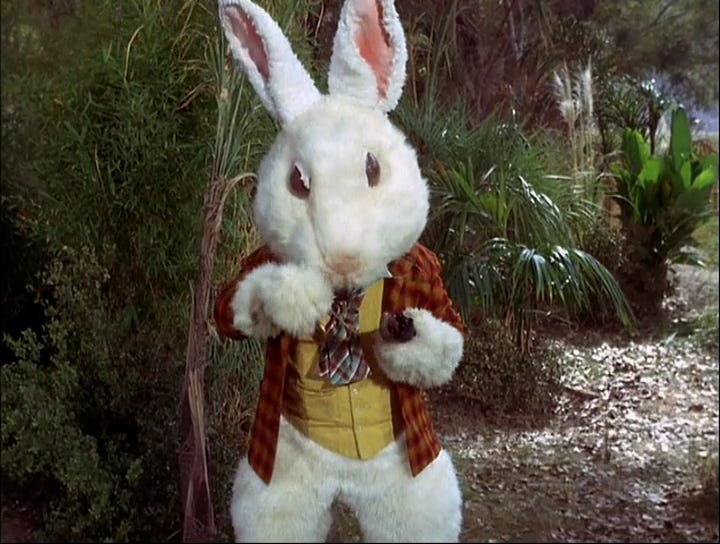
The wascally wabbit.
On cue, McCoy sees a giant white rabbit, followed by Alice. Sure, it looks like someone in a large rabbit suit, but that’s okay with me. I think most audiences of the time understood its limitations. Besides, the dollop of cheesiness inherent in Star Trek has always been endearing to me. I don’t care what the producers and the network thought, I’ve always found this to be one of the best teaser hooks in the series’ history. It’s so totally unexpected, so unlike anything viewers have seen to date. This is arguably the first episode to indulge in whimsy, which the show needed if it was going to grow.
We’re introduced to another two-person scouting party. One of them is Lt. Angela Martine, the woman who was to marry Lt. Robert Tomlinson, killed in the Romulan battle in “Balance of Terror.” She seems flirtatious with her colleague, Lt. Esteban Rodriguez, so her grief apparently didn’t last long. The scene suffers from a continuity glitch; she’s still “Angela” but her last name is now Teller; according to Memory Alpha, the character was originally Mary Teller in the script. This reflects the haste with which the episode was rewritten.
Kirk beams down to the glade with Yeoman Barrows. They find McCoy, who points to giant rabbit footprints in the soil. Shots are heard; the three run to find Sulu, firing an antique gun for target practice. Sulu fires four shots from the six-shooter, which should leave two bullets. He found it lying nearby in the grass, and comments how he’s always wanted one for his collection. Kirk takes it and tucks it into his waistband, one way to assure the Kirk line ends with the current generation.
Kirk assigns Sulu and Barrows to follow the rabbit tracks, while he and McCoy return to the glade. We see an antenna pop up behind them, tracking their moves.
McCoy comments he feels like he’s being picked on, which reminds Kirk of Finnegan, an academy upper classman who always bullied him. Sure enough, Finnegan appears. Before they can exchange punches, Kirk hears Barrows scream. Kirk and McCoy finds Barrows the victim of a sexual assault by Don Juan.
The doctor stays with the yeoman while Kirk runs off to find Sulu. He encounters Ruth, his first true love. Spock calls to advise that some sort of industrial activity within the planet is drawing power from the Enterprise.
As McCoy and Barrows flirt, she wishes she could find a “fairy-tale princess” costume. Sure enough, one appears. Bones encourages her to put it on.
Sulu finds Kirk. The phasers no longer work. Because communications are out, Spock beams down to personally brief the captain. The transporters won’t work either.
Back at the glade, a black knight skewers and kills McCoy. (So who says, “He’s dead, Jim”?) Kirk fires three shots from the six-shooter, for a total of seven, to kill the knight. Hmmm, maybe the planet automatically replenishes the bullets?! Or maybe it’s one of those TV guns with an infinite bullet supply.
Speaking of bullets … Back at Rodriguez and Martine/Teller, they’re strafed by two different stock footages. One is a World War II US prop fighter, the other a Japanese Zero. The latter kills Angela.
While they’re distracted by the Zero, the bodies of McCoy and the black knight disappear. Finnegan reappears; Kirk chases after him. They run around Vazquez Rocks beating the crap out of one another. Spock arrives to tell Kirk they’re manifesting thoughts and need to learn how to control them.
Back at the glade, the caretaker arrives to explain things. The planet is a giant amusement park. McCoy reappears, quite alive, with two showgirls on his arms. In another continuity glitch, Barrows tunic is torn at the left shoulder; it was the right shoulder earlier in the episode. Martine has also magically reappeared, suddenly standing next to Rodriguez without explanation, most likely due to a deleted scene. The caretaker convinces Kirk to allow his crew shore leave with proper precautions.
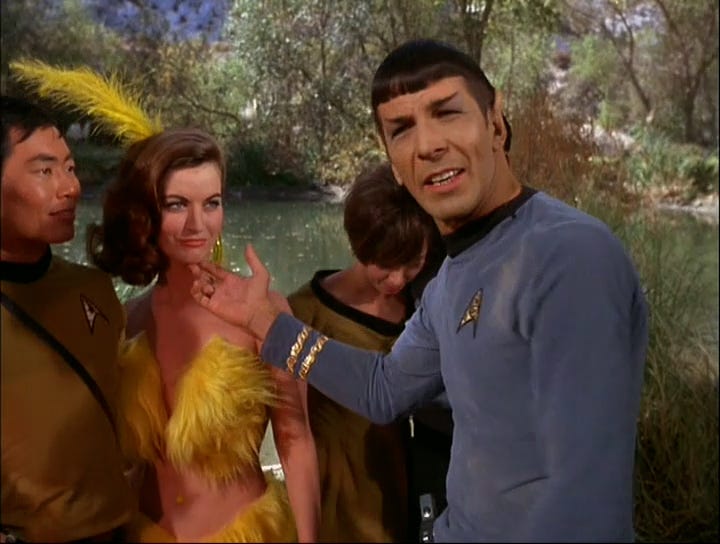
Spock shows a certain fascination with one of the showgirls. Atypical for his character.
And it’s back to Desilu we go. I suspect the cast and crew must have enjoyed being off the lot for the first time, although that brings its own new headaches and inconveniences. All the continuity errors and artificial lighting reflect yet one more learning experience for the production team.
Despite all the rewrites, Theodore Sturgeon received the writing credit. He’ll return with “Amok Time.”
“On Hand: A Book by Theodore Sturgeon,” Venture Science Fiction, September 1957, 49.
Joel Engel, "Gene Roddenberry: The Myth and the Man Behind Star Trek” (New York: Hyperion, 1994), 44.
Gene Roddenberry, “Star Trek Is,” March 11, 1964, 14. Marc Cushman, These Are The Voyages: TOS Season One (San Diego: Jacobs/Brown Press, 2013), 414.
Some of Sturgeon’s impractical ideas, such as the mechanical arms, finally made it to the screen in the animated Star Trek series episode, “Once Upon a Planet.”
Cushman, 418.
Cushman, 429.