

Your guess is as good as mine.
Star Trek’s Pothole
Ask Star Trek fans to name their favorite original series episode, and you’ll hear many opinions.
Less often asked is, “What is the worst episode?”
For me, “The Alternative Factor” is an all-time stinkeroony.
Hollywood.com, a website owned by the founders of the Sci Fi Channel, in 2024 ranked all 79 TOS episodes, from worst to best.
“The Alternative Factor” came in at #77. The only worse episodes, in their opinion, were #78 “Spock’s Brain” and #79 “Turnabout Intruder.”
The latter two were third-season episodes, when TOS writing declined in quality. “The Alternative Factor,” however, was a mid-first season episode, when TOS was just starting to find its groove.
My article joins several predecessors who have delved into this bottom feeder. Michael Kmet wrote a three-part blog over 2016-2018 exploring what went wrong with the episode.
As we’ve discussed in earlier columns, before the first season Gene Roddenberry sought writers who generally fell into two categories — veteran television writers, and science fiction literature writers. Rarely did those two categories cross, although a few had written for SF shows such as The Twilight Zone, The Outer Limits, or other genre shows of the era.
Don Ingalls, who pitched this episode, fell into the first category, although he was not among the first TV writers hired to write the early scripts.
The Blues Brothers
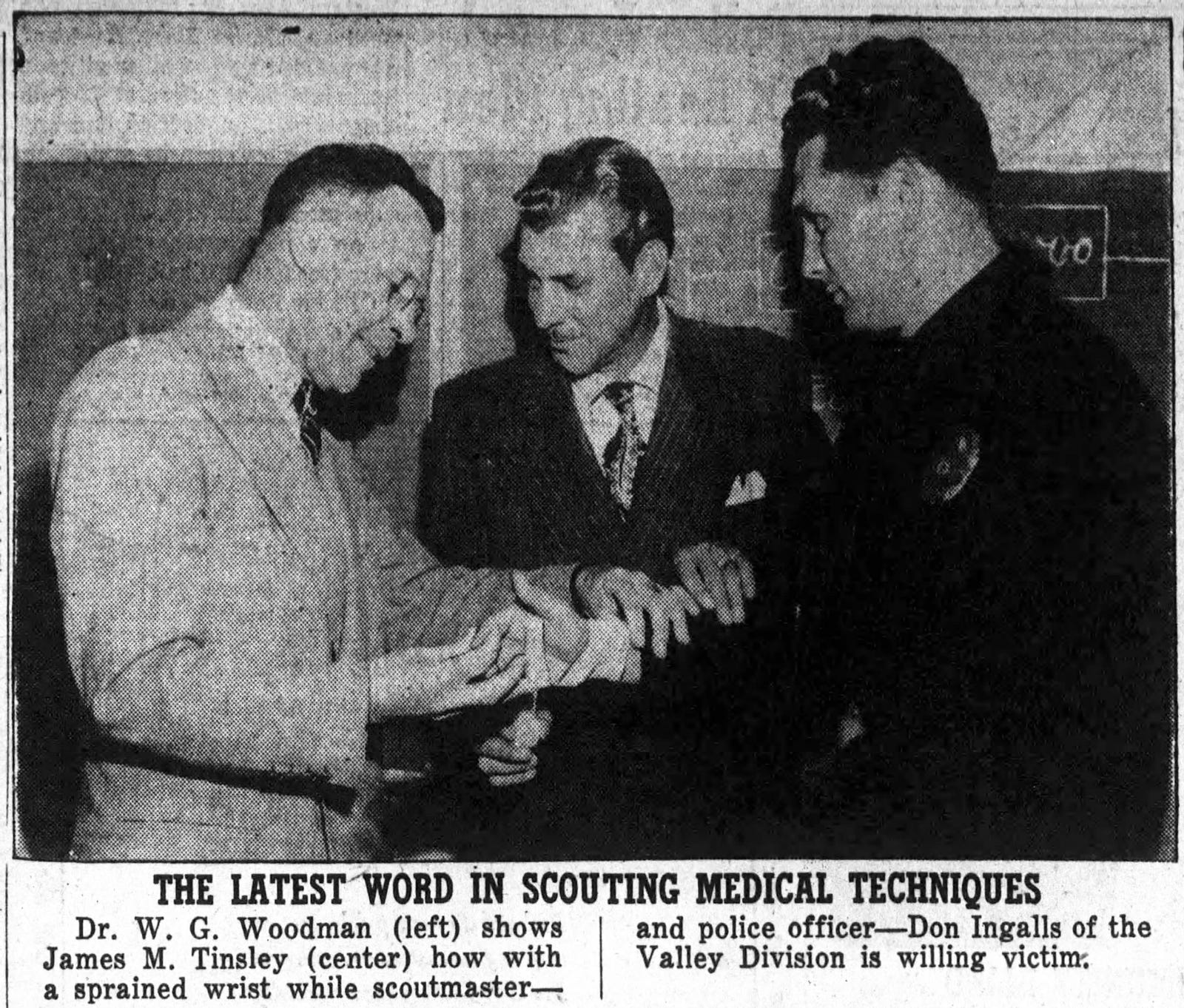
Don Ingalls (right) with the Los Angeles Police Department in 1947. Image source: Hollywood Citizen-News, October 23, 1947, via Newspapers.com.
Ingalls’ writing career ran in parallel to Roddenberry’s in the late 1950s and early 1960s. That’s not a coincidence.
In his authorized Roddenberry biography, Star Trek Creator, David Alexander wrote about Roddenberry and Ingalls serving together in the Los Angeles Police Department. These brothers in blue were assigned as speechwriters to chief Bill Parker’s public affairs division. Ingalls left the LAPD before Gene, but both left to pursue full-time their screenwriting careers.1
Like most enduring relationships, they had much in common. Both had been B-17 pilots during World War II. Both were aspiring writers. Alexander wrote about another shared trait: “an appreciation of beautiful women and failing marriages.”
Ingalls had his own distinguished screenwriting career. Like many TV writers of his time, Ingalls sold scripts to several Westerns, such as Tombstone Territory, Bat Masterson, and nine episodes of Have Gun — Will Travel. He wrote an episode in 1960 for Patrick McGoohan’s Prisoner predecessor, Danger Man. But by 1966 he had no experience with the science fiction genre.
According to his unauthorized biographer, Joel Engel, Roddenberry gave Have Gun — Will Travel producer Sam Rolfe a spec script written by Ingalls, which led to Ingalls joining the writing staff. Engel wrote, “Ingalls and Roddenberry became chess partners, business partners, and good friends.”2
From December 1956 to April 1958, Ingalls wrote a column for the San Fernando Valley Times called “Valley Roundup.” In several columns, Ingalls told tales about Roddenberry. In the June 27, 1957 edition, Ingalls wrote about his professional relationship with Roddenberry. While working together at the LAPD, “I used to drop him little kind hints as to what was wrong with his stories. Then we drifted apart.”
If the two were estranged, they soon reconciled. Kmet documented that Ingalls, as head writer on a Western called Whiplash, hired Roddenberry in 1959 to write four episodes. The two collaborated on developing a Western anthology called The Weapon but their project was abandoned by 1961.
Years later, Ingalls decided to drop in at the Roddenberry home. Observing how busy Gene was with script assignments, Ingalls concluded, “I somehow felt old friend Gene didn’t need me anymore.”
As Roddenberry was preparing to produce the first season of Star Trek, Ingalls was associate producer on a crime drama called Honey West, about a female private detective. The show lasted only one season, from September 1965 to April 1966.
David Alexander wrote that Roddenberry shared with Ingalls his Star Trek “series presentation.”3 Perhaps this was the sixteen-page, March 11, 1964 outline called “Star Trek Is …” we’ve cited in earlier columns.
According to Marc Cushman in These Are the Voyages, Ingalls submitted his story outline on August 29, 1966.4 Star Trek was well into production by then, but no episodes had aired. When he might have been recruited by Roddenberry appears lost to history, but one can imagine Gene offering his friend a chance to sell a script. Kmet suggested that Ingalls was too busy with other assignments to be among Roddenberry’s earliest free-lancers.
Ingalls posited “an interplanetary hunter” named Lazarus. Why this character happens to share the same name as a New Testament figure is unexplained. “His game? A creature — a humanoid monster that destroyed his civilization on a far distant planet.” The monster was an alternate world version of himself.
Roddenberry, Gene Coon, and Bob Justman saw a kernel of an idea in the outline but found it deficient. Coon called the outline “so sketchy” with “no specific idea for what kind of action.”
Lazarus charmed a female crew member named Charlene Masters, who wound up betraying the crew so he could steal the ship’s dilithium crystals. But “Space Seed,” the upcoming episode with Khan Noonien Singh and 20th Century Earth’s genetic supermen, also had a traitorous crew member seduced by the antagonist. Masters’ role in the story was diluted.
The No-Show
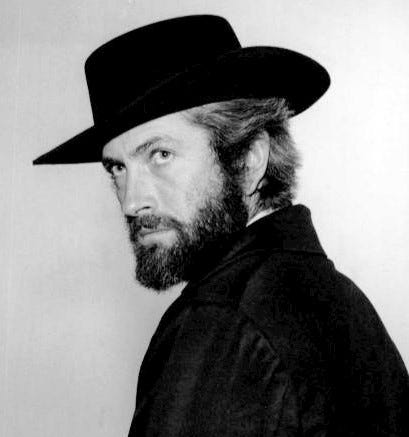
John Drew Barrymore in 1964. Image source: Wikipedia.
Roddenberry sought and signed John Drew Barrymore (Drew Barrymore’s father) to play Lazarus. A scion of the legendary acting Barrymores, he was a violent alcoholic, a disease that ran in the Barrymore family. On October 16, 1966, a month before the episode was to film, he was arrested in San Bernardino during a narcotics raid and charged with possession of marijuana. Barrymore posted $3,300 bail.
According to Cushman, the episode was scheduled to begin filming on November 16. Barrymore’s first day of filming was to be the next day. But late in the afternoon, Barrymore sent word that he wouldn’t show. The role was recast that night with Robert Brown, who had once worked with William Shatner in an unsold TV pilot called Colossus. Roddenberry called Brown and said that Shatner had recommended him.5
The chaos couldn’t help but contribute to the episode’s production flaws. Brown fit Barrymore’s costume, but his makeup would be inconsistent. A beard appliance was glued to his face on-the-fly. When filming moved to Vasquez Rocks, a much thicker beard was applied by the location makeup team. Location shooting ran late in the day, so mirrors were used to shine artificial light onto the actors.
Gerd Oswald was an accomplished director. He served as a second unit director on the 1962 World War II epic The Longest Day. He directed fourteen episodes of The Outer Limits. Earlier in the season, Oswald directed “Conscience of the King.” But this stinker ran a day behind schedule. The last scenes filmed were of Kirk and Lazarus in the interdimensional corridor between the positive and negative universes. Brown wore a fluorescent costume with black lights shining on him. Oswald wasn’t invited back.
NBC rearranged the broadcast schedule so “The Alternative Factor” didn’t air until March 30, 1967, near the end of the season. The next episode to air would be “City on the Edge of Forever,” arguably the series’ best episode.
Positives and Negatives
Michael Kmet’s blog series included excerpts from Ingalls’ pitch, various memos, and script drafts. They’re well worth your time if you’re so inclined.
We learn from the drafts that the two versions of Lazarus in the script were called Lazarus #1 (the evil one) and Lazarus #2 (the good one). Ingalls’ scripts and other documents are available to the public at Pepperdine University.
You might think we first meet #1, but it’s actually #2 according to the script. Let’s meet them both — for better or for worse.
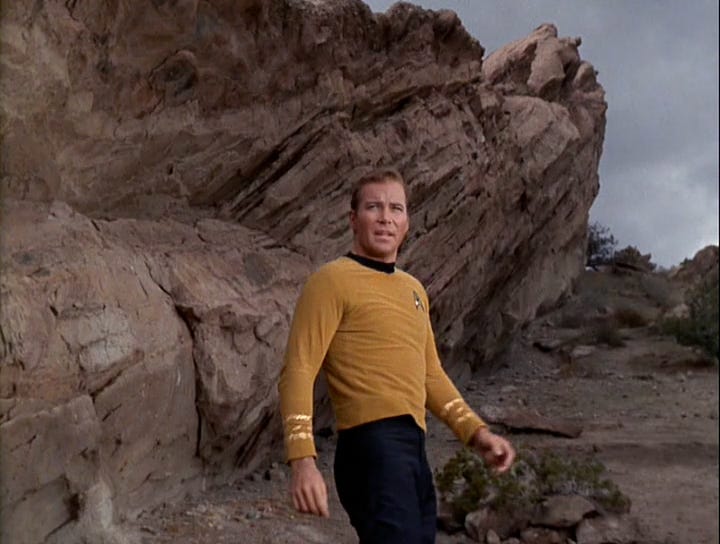
This place looks familiar …
The teaser opens with the Enterprise in orbit around a very mundane planet with no life and a surface that might remind you of Vasquez Rocks. Lieutenant Leslie is at the helm; perhaps Sulu has the day off. “No surprises,” as Spock says.
Famous last words …
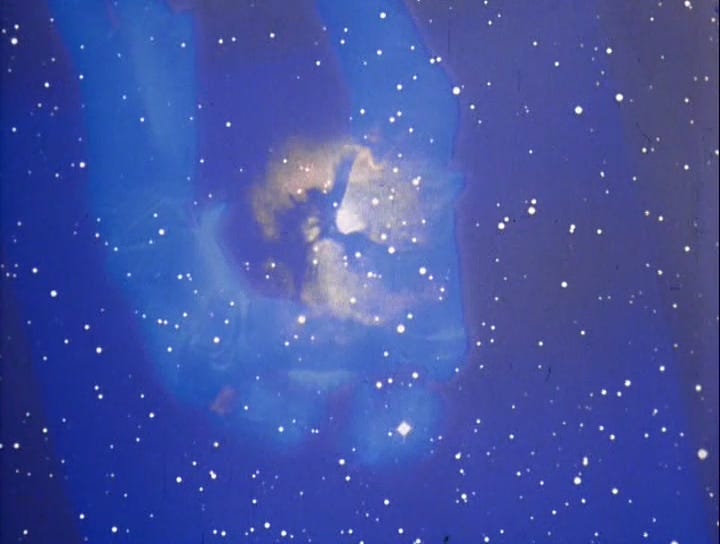
The ship is rocked by a phenomenon that throws about the crew, often to be mocked in future parodies. A nebula image is superimposed over the bridge footage.
”The entire magnetic field in this solar system simply … blinked,” Spock says. (Spoiler — a solar system doesn’t have a magnetic field. Planets and stars do.) The mundane planet for an instant converted to “zero gravity.” (Another spoiler — if it has mass, it has a gravitational pull.) Spock describes the phenomenon as “nonexistence.” (Well, if it doesn’t exist, it doesn’t have mass, so I guess it wouldn’t have gravity.)
Uhura reports that she’s received a “standard general alert signal from Starfleet Command.” In the last produced episode, “Arena,” the term “Starfleet Command” was used for the first time, created by producer Gene Coon. Since he polished this script too, most likely he inserted this line.
Spock now detects a humanoid life form on the surface, and advises it’s “very possible” that this being could pose a threat to the ship. It’s the perfect opportunity for Kirk to beam down with Spock and “an armed attachment of men.” Will we lose more redshirts? We’ll find out after the title credits.
The landing party materializes. I wonder if Kirk thinks, “I was just here last week …” They find a very small pod. “You came!” Lazarus #2 cries from a rock above. “We can still stop him!” He passes out and falls unconscious. Kirk beams up #2 to the Enterprise with all redshirts alive and well.
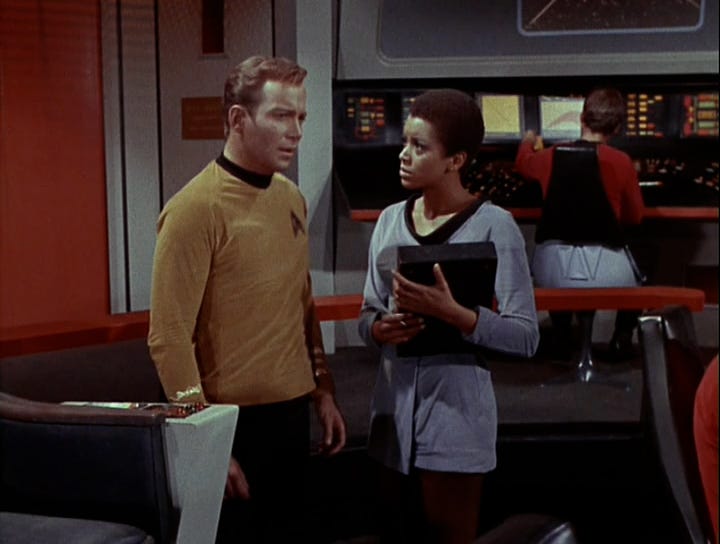
Janet MacLachlan as Charlene Masters briefs the captain.
On the bridge, we meet Lt. Charlene Masters, who was to be a love interest for Lazarus but now appears to be the latest surrogate for the departed Janice Rand. Masters wears a blue science uniform, not Rand’s red command color. She tells Kirk that the phenomenon has all but drained their “dilithium crystals.” This is the first time the word “dilithium” has been used. We heard of “lithium” in the second pilot, “Where No Man Has Gone Before,” and “lithium crystals” in “Mudd’s Women.” Most likely this was another addition by Gene Coon. Kirk displays his talent for exposition — “Without full crystal power, our orbit will begin to decay in ten hours.” That’s why he’s the captain.
Another message is received from Starfleet Command — “Code Factor One,” meaning invasion. How did the admirals leap to that conclusion? Kirk orders the crew to battle stations. A commodore calls to say that the effect was felt “in every quadrant of the galaxy and beyond.” Hmm, does Starfleet have intergalactic probes collecting data? The phenomenon originated from the planet below. The commodore is evacuating all starships and personnel within 100 parsecs of the Enterprise.
(Fun fact … A parsec — short for parallax second — is about 3.26 light years or 19 trillion miles / 31 trillion kilometers.)
Kirk interrogates Lazarus (#2), who explains he’s pursuing a “hideous murdering monster” who destroyed his civilization. Lazarus asked for Kirk to join him in his “holy cause” but Kirk wants more facts. He’ll beam down with Spock, redshirts, and Lazarus.
Here’s where the show runs off the nacelles. The nebula effect flashes, Lazarus runs off, we hear voiceovers of threats and challenges to confront the nemesis. We see a fluorescent wrestling match between two figures that seems inexplicable to we the viewers. The camera spins, adding to our confusion, for we can’t really see what’s going on.
When it’s over, this Lazarus screams, “Kill! Kill! Kill!” Is this #1 or #2? It’s all but impossible to keep track — which perhaps was the point.
Lazarus is returned to Sickbay, where McCoy places a bandage on his head. The bandage is to help us keep track of #1 versus #2, but it seems to be inconsistently applied.
“I’m just a country doctor,” McCoy tells Kirk for the first time, but not the last.
Apparently Security has taken the day off as well, because Lazarus freely roams the corridors. He’s in the rec room, where Masters is enjoying a coffee with other crew members. Lazarus overhears her mention dilithium crystals.
Kirk takes Lazarus to the bridge (!) where Spock shows a “rip in the universe” emanating from the pod. Lazarus begs for the dilithium crystals to trap his enemy.
Lazarus, apparently #1, sneaks into Engineering and steals the crystals. (It’s implied later on that he swiped two of four.) #2 insists it wasn’t him, it was his enemy. Kirk decides to beam down with Lazarus, Spock, and redshirts to search for the crystals. Lazarus’s beard sure is a lot thicker after beaming down.
Lazarus wanders off by himself. Wow, not only is Security having a bad day, but so is Kirk. The Lazaruses (Lazarii?!) tussle again, padding the episode’s running time. This Lazarus inexplicably falls from a Vasquez rock and is transported back yet again to Sickbay. Back and forth we go. Pad, pad, pad …
Lazarus finally reveals the truth. His pod is a “time chamber, a time ship” and claims to be a time traveler. He once again pleas for help to destroy his enemy.
Kirk replies, “I’ve got 430 other men to worry about.” Captain Exposition strikes again. In “Charlie X” the crew complement was 428. Apparently two dead crew members were replaced.
McCoy demands the security “muscle man” be dismissed from Sickbay. Kirk relents — which means Lazarus is soon to escape yet again. Sheesh.
Kirk and Spock finally figure out that the radiation is coming from a parallel universe, the possibility of which Spock says “has been scientifically conceded.” They reason that there’s not one Lazarus, but two, from separate universes. One is matter, the other antimatter. If they meet … “absolute total annihilation.” They incorrectly state that the annihilation happens only if two identical objects touch one another; if the antimatter Lazarus has been in our universe, he should have blown up real good long ago.
As an aside, the “many worlds theory” began with Princeton University graduate student Hugh Everett III in 1957 to explain paradoxes in quantum measurements. It’s still debated today, with no conclusive evidence one way or the other or the other or the other … Star Trek will revisit the concept in the second season episode, “Mirror, Mirror.”
Using his somehow miraculous knowledge of Starfleet circuitry, Lazarus cross-wires Engineering circuits to create a diversion so he can steal two more dilithium crystals. He then operates the transporter to beam down, more miraculous knowledge.
In yet another incredibly bad example of command skills, Kirk beams down by himself, after ordering Spock to organize a security detail and follow. NBC had bugged the production team to make the episodes more Kirk-centric so that probably explains this illogic.
Kirk reaches into the pod and finds himself in the “antimatter universe.” (No kaboom.) The pod is now on an interior stage, possibly filmed here because production ran out of time at Vasquez Rocks. The #2 Lazarus tells him that the scheme is to trap both Lazarii in the corridor between universes. Kirk returns to the matter universe and forces Lazarus through, then off-screen destroys the pod.
Fin. At least no redshirts perished.
At a time when the concept of a multiverse was just starting to emerge in science fiction, this episode was a golden opportunity for Star Trek to boldly go where SF television had never gone before. But, like matter and antimatter coming into contact, it went kaboom.
David Alexander, Star Trek Creator: The Authorized Biography of Gene Roddenberry (New York: Penguin Books, 1994), 108, 114.
Joel Engel, Gene Roddenberry: The Myth and the Man Behind Star Trek (New York: Hyperion, 1994), 145-146.
Alexander, 199.
Marc Cushman with Susan Osborn, These Are The Voyages: TOS Season One (San Diego: Jacobs/Brown Press, 2013, 463.
Cushman, 469-470.