

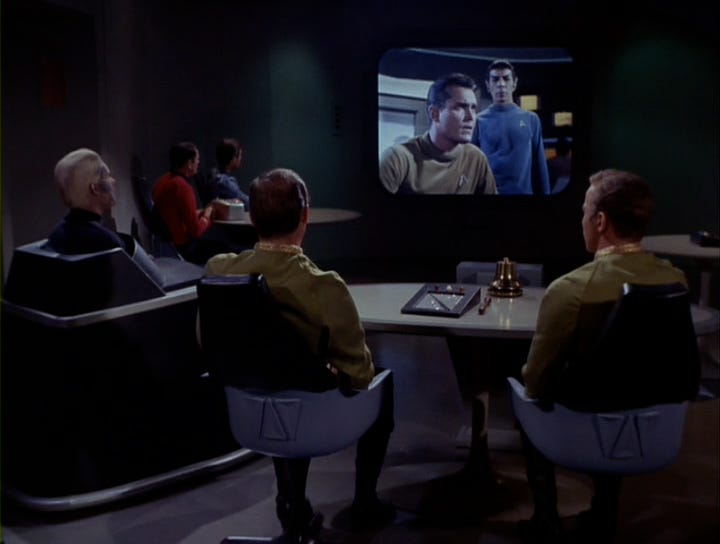
Meanwhile, in the Enterprise man cave …
Waste Not
Star Trek was in the red.
In his omnibus review of original series episodes, Marc Cushman wrote that, after production of “Court Martial,” Star Trek for season one was $33,618 over budget.1
When Gene Roddenberry first pitched Star Trek to Desilu, and then to NBC, he had promised that the show would be affordable and on schedule. Neither turned out to be true.
Associate producer Bob Justman concluded mid-season, “We’d be unable to deliver the last third of our shows in time. I finally came to a decision — the right thing to do was to tell NBC about our problem.” But Desilu executive Herb Solow told him not to worry, because the Thanksgiving show would be preempted for a special, and Nielsen ratings would be ignored for Christmas week so that episode could be a repeat.2
Despite those mulligans, Roddenberry from the earliest days of pre-production was looking for ways to save time and money.
Most TV shows are sold to a network by producing a pilot. If the show sells, the pilot typically serves as the series’ premiere episode, but not always. It’s not unusual for a studio or network to ask for a second pilot that fixes concerns with the first attempt.
In the 1960s, for example, Gilligan’s Island and Lost in Space had unaired pilots. Voyage to the Bottom of the Sea recycled the 1961 movie’s premise and effects into the January 1966 episode, “The Sky’s on Fire.” In more recent times, The Big Bang Theory had an unaired pilot with a different female lead character, and no Howard or Raj.
So second pilots were nothing unusual when NBC and Desilu asked for a redo. Contrary to myth, the network didn’t reject the first pilot “The Cage” because it was too cerebral. As we documented in that column, NBC wanted an episode with a bit more zip that might appeal to potential sponsors — hence the second pilot, ”Where No Man Has Gone Before.”
The second pilot aired on September 22, 1966, the third episode to air. It had a different opening teaser than the one shown to sponsors.
The original teaser for “Where No Man Has Gone Before,” as shown to sponsors but not to network audiences. Video source: Tales From SYL Ranch DARKROOM YouTube channel.
“Where No Man Has Gone Before” sold the series, but Roddenberry still intended to use “The Cage.” The challenge was how to recycle the first pilot into the series, since Spock was the only character to have appeared in both pilots.
On March 21, three weeks after buying the series, NBC agreed that a two-part version of “The Cage” could be included in the first sixteen episodes ordered by the network. (“Where No Man Has Gone Before” could also be included.) According to Cushman, NBC had certain conditions — at least half the content must include the current cast, and NBC would only pay for one of the two episodes. Desilu reluctantly agreed, giving Roddenberry more time to produce the remaining thirteen episodes.3
The “envelope” story containing “The Cage” was assigned to John D.F. Black, whom Roddenberry had hired as story editor. Black’s first pass was called “From the First Day to the Last,” but was set aside as he worked on other scripts in pre-production. Before he left the show in early August, Black submitted his first draft teleplay on August 12.4
In his unauthorized Roddenberry bio, Joel Engel wrote that the seminal ideas in the “envelope” story came from Black, but the aired episode gave writing credit solely to Roddenberry. As did many other writers that first season, Black filed for arbitration with the Writers Guild of America. Black but didn’t file a statement, but Roddenberry did; Black believed a comparison of the two drafts was sufficient. According to Engel, “The story of Spock abducting the scarred and crippled Capt. Christopher Pike … was originally devised by John D.F. Black.” According to Cushman, Roddenberry came up with the idea. With no supporting statement from Black, the WGA sided with Roddenberry.5
A surviving copy of Black’s draft seems to show Cushman is right. Pike was not abducted in Black’s version; Spock talked Kirk into helping return Pike to Talos IV. One could argue that because all of “The Cage” was written by Roddenberry, much of the script had already come from Gene before Black began writing the envelope. In fact, the surviving draft has pages inserted directly from Roddenberry’s November 25, 1964 draft, when “The Cage” was called “The Menagerie.” It’s interesting to note that, in that draft, Pike was called “Winter.” Roddenberry’s original name for the captain was Robert T. April, then James Winter, and finally Christopher Pike.
In November 1966, before “The Menagerie” aired, Roddenberry was notified by organizers of the World Science Fiction Convention (Worldcon) that Star Trek would be nominated for a Hugo Award, for Best Dramatic Presentation. According to Engel, Gene submitted “The Menagerie,” an episode with his name on it. The Hugo Awards website shows two other Star Trek episodes were nominated, “The Corbomite Maneuver” and “The Naked Time.”6 Two movies were also nominated, Fantastic Voyage and Fahrenheit 451. When the awards were handed out in September 1967, “The Menagerie” won.7
Another legal speed bump was compensating the original actors for reuse of their performances. Jeffrey Hunter, who had played Pike, was paid $5,000. Most of the cast were paid $750 each. Marc Daniels, who would direct the envelope footage, would get credit for Part 1 while Robert Butler, who had directed “The Cage,” would get credit for Part 2.8
Hunter’s wife felt Star Trek wasn’t right for him, so he declined returning for the envelope. Roddenberry came up with the idea of Pike being scarred beyond recognition.9 (In Black’s draft, Pike was injured but recognizable.) Pike was played by a heavily disguised Sean Kenney, who went on to play Lieutenant DePaul in two episodes.10
The two-parter helped Star Trek get back in the black for season one. But it cost Roddenberry his film editor, Robert L. Swanson, who was burned out. Swanson couldn’t handle Roddenberry’s constant meddling. But it was Gene’s show, and “The Menagerie” was a big risk, so one can understand.11
The Menagerie, Part 1
The Enterprise has been summoned to Starbase 11. We were just at Starbase 11 in the last episode, “Court Martial.” The planets appear similar (blue) as do the buildings. Maybe returning to the same starbase helped recycle existing footage and effects. (Waste not.)
In “Court Martial,” Commodore Stone was in charge, but now it’s Commodore Jose Mendez. According to Kirk, Spock had received a message from the former commander of the Enterprise, “fleet captain” Christopher Pike, requesting the starship divert to Starbase 11. Mendez says that’s impossible and takes them to the medical ward.
For canon nitpickers … Kirk says he met Pike “when he was promoted to fleet captain.” In the prequel series Strange New Worlds, Kirk has visited Pike’s Enterprise several times. They’re quite familiar with one another.
Pike is in a futuristic wheelchair. Only his head and torso are visible. He’s horribly scarred and disfigured from exposure to delta rays. He can’t speak, only flash a light once for yes and two for no.
He’s flashing no.

Stephen Hawking in his wheelchair. Image source: How It Works.
By 1960s standards, this might have been plausible, but today we know that with neural implants and AI technologies it’s laughable. Stephen Hawking communicated for years by twitching his cheek muscle to navigate an on-screen keyboard.
Left alone with Pike, Spock proposes “treachery” and “mutiny.” Pike keeps signaling no. There’s a teaser for you.
And we go to the title credits.
The evidence suggests Spock faked the message, but Kirk can’t accept that. As he and Mendez argue, Spock sneaks into the starbase data center and transmits top secret orders to the Enterprise computer. Spock tells the bridge crew that they’re not to discuss the mission with other crew members or with starbase staff.
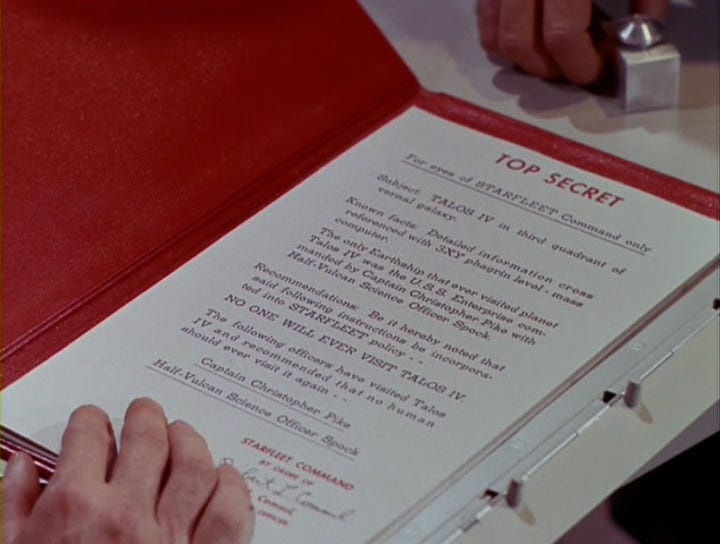
Always read the fine print.
Mendez shows Kirk a booklet with a few details about Talos IV. Visiting that planet is the only remaining death penalty. The secret document reveals that the Enterprise once visited Talos IV. Two officers recommended that “no human should ever visit it again” — Captain Pike and “Half-Vulcan Science Officer Spock.”
Kinda racist to use his ethnicity as an appellation.
After tricking McCoy into returning to the ship, Spock spirits Pike onto the Enterprise and warps out of orbit. Kirk and Mendez pursue in a shuttlecraft. When the shuttle runs out of fuel, Spock has no choice but to beam them aboard. He executes a new program that brings the starship to a stop. Spock surrenders to McCoy and admits committing mutiny. With Kirk and Mendez on board, the Enterprise resumes its course to Talos IV.
A court martial is convened, using the same set, props, and procedures just filmed in “Court Martial.” (Waste not.) The three judges are Mendez, Kirk, and Pike.
At Spock’s request, the viewscreen is activated. Here’s where we begin to see the recycled footage from “The Cage.” Pike verifies its authenticity.
Thirteen years ago, the Enterprise picked up a distress signal from the SS Columbia, lost eighteen years before that. Columbia crash-landed on Talos IV.
For canon nitpickers … The events of “The Cage” predate the events of Discovery and Strange New Worlds. Fan sites suggest “The Cage” happened in 2254. Pike returned to Talos IV with Discovery circa 2258. SNW begins around 2259. If “The Menagerie” occurs thirteen years after “The Cage,” then it’s now 2267.
A landing party of six, led by Pike, beams down to the Talosian surface. The landing party finds elderly survivors of the Columbia crash, and a young blonde named Vina. She was born during the crash, so theoretically she’s eighteen, although Susan Oliver was 32 at the time of filming. Vina lures Pike to a door hidden in the rocks where he’s snatched by the Talosians. Vina and the Columbia survivors disappear. Hand lasers appear useless against the rock face.
The presentation is interrupted by a message from “Fleet Command.” The Enterprise has been receiving the transmission from Talos IV, “in violation of Starfleet general orders.” Kirk is relieved of command, with Mendez now in charge.
The court is in recess.
End of Part 1.
The Menagerie, Part 2
The episode opens with a surreal minimalist restaging of the trial to date. Kirk, Spock, and Mendez stand erect against a dark background. Mendez recites the charges, to which Spock answers guilty. Kirk’s voiceover recaps plot points so far.
The story resumes after the title credits. Spock informs us that the Talosian Keeper has taken control of the viewscreen. Pike is imprisoned in their zoo. He discovered that the Talosians can speak, but prefer to use telepathy. They generally gaslight him.
Back aboard the Enterprise, Number One and the senior staff decide to use a giant laser cannon to blast through the rock face door. When it doesn’t work, they realize that maybe it did work, but they can’t see it because of a Talosian illusion. It must have looked bitchin’ in 1966 on increasingly common color home TV sets. Cushman cites a December 7, 1966 memo (right after Part 2 aired) from Desilu exec Herb Solow noting that Star Trek is the highest-rated color TV show in its time period.12
Hoping to seduce Pike, they show him various illusions hoping he’ll want to stay and mate with Vina. None of them work. But back in our present day, at the court martial, Spock makes the point that Pike experienced these illusions in his mind as reality — which foreshadows where Spock is going with all this. Spock tells Kirk that the Talosians care about him and want him back.
The Enterprise crew attempt to beam down a rescue party into the menagerie, but only the women go through. The Talosians have concluded that Pike needs a variety of women from which to choose. Number One reveals that the Columbia manifest listed an adult Vina, so she’s much older than we’ve been led to believe. Eighteen, she is not.
Pike captures the Keeper. With the women, they escape to the surface. The Keeper says this is where they wanted the humans all along, to repopulate the planet. Number One sets her laser on overload; suicide is better than enslavement, not just for them but also for a future enslaved human race. The Talosians conclude that humans are too dangerous and violent, so they’re free to go. Pike is shown Vina’s true appearance — she’s old, bent, and scarred. She must stay to keep her illusion of youth and vitality.
And this is why we’re here.
Mendez disappears; the Keeper tells Kirk that he never left starbase. The Keeper also reveals that Spock has been in communication with the Talosians all along. This ruse has been to convince Kirk that Pike should be given the choice to return to Talos. Starbase 11 received the transmissions too; Mendez waives the general order and drops all charges.
Pike chooses to live out his days on Talos with Vina.
Fin.
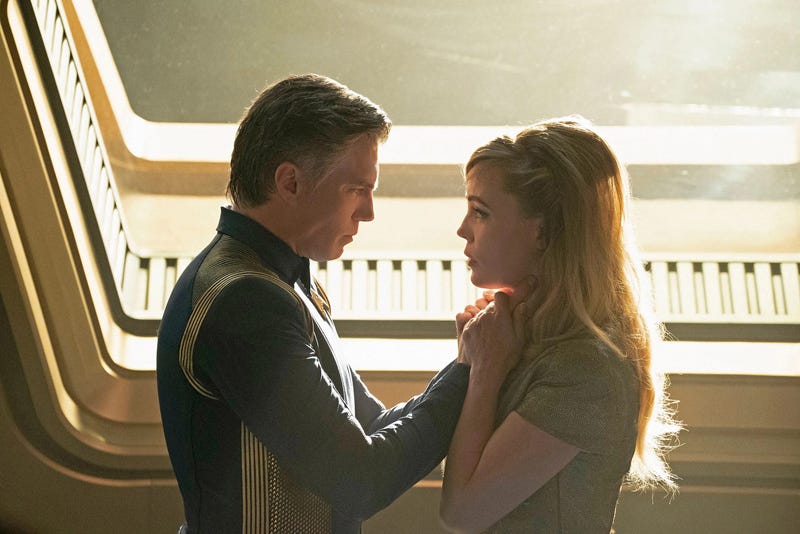
In the Star Trek Discovery episode, “If Memory Serves,” Pike and Vina reunite four years after the events of “The Cage.”
Although it seems a bit padded at times, “The Menagerie” truly is a masterpiece — not necessarily for the writing, but for the ingenious “envelope” gag. Roddenberry, Black, and Coon made it work. The viewing audience probably never knew the difference.
Lexicon Notes
In the surviving copy of John D.F. Black’s first draft, Kirk refers to “UESPA regulations.”13 It’s an abbreviation for United Earth Space Probe Agency. The word “Starfleet” was first used in “Court Martial'“; McCoy was described as having been “decorated by Starfleet surgeons.” In “The Menagerie,” the terms “Starfleet general orders” and “Starfleet Command” are used to specifically describe what up to now has been the UESPA, more or less.
David Alexander cites a September 29, 1966 memo from Roddenberry to “all concerned” urging the use of the prefix “star-” more often in scripts. “It appears we may have a useful catch-word deriving out of Star Trek in our title.” He noted how Batman was using “bat-” as a prefix for various terms. At the time, Gene Coon was doing the final polish on “Court Martial,” and Roddenberry was working on final drafts of “The Menagerie.” This probably explains why “Starfleet” entered the lexicon when it did.14
In Black’s draft, Commodore Mendez was Commander Jermane. The commander outranked the captain, which is inconsistent with US naval ranks, but this ain’t the navy. Or so we’re told. Jermane was actually a Talosian who replaced Jermane, not an illusion as Mendez became.
“The Cage” used the word “laser” instead of “phaser.” The term “Class M” for an Earth-like world was also used in the first pilot. (“Class M” is not a thing in astronomy, in case you’re wondering.)
Marc Cushman, These Are The Voyages: TOS Season One (San Diego: Jacobs/Brown Press, 2013), 376. $33,618 is about $332,000 in today’s dollars, according to the US Bureau of Labor Statistics CPI Inflation Calculator.
Herbert F. Solow and Robert H. Justman, Inside Star Trek: The Real Story (New York: Pocket Books, 1996), 249-250. This recollection is contradicted by the air dates. “The Menagerie Part 1” aired on November 17, 1966. “Part 2” aired on Thanksgiving Day, November 24, which is confirmed by newspaper listings. A Jack Benny special preempted Star Trek on December 1 in some markets; listings in some newspapers show Star Trek in its normal slot so perhaps those markets saw a repeat.
Cushman, 380.
Cushman, 380-381. Part 2 of “From the First Day to the Last” is at this Dropbox link. Part 1 seems to be unavailable.
Joel Engel, Gene Roddenberry: The Myth and The Man Behind Star Trek (New York: Hyperion, 1994), 118. Cushman, 381, 382.
“The Naked Time” aired on September 29. “The Corbomite Maneuver” aired on November 10. “The Menagerie Part 1” would air on November 17, and Part 2 on November 24. If Engel is correct, then it suggests the Hugo committee cut off nominations between November 10 and 17.
Engel, 119-121. “1967 Hugo Awards,” Hugo Award website.
David Alexander, Star Trek Creator: The Authorized Biography of Gene Roddenberry (New York: ROC Penguin Books, 1994), 258-259.
Cushman, 381.
“DePaul,” Memory Alpha website.
Solow and Justman, 248-249. Cushman, 388-389.
Cushman, 390-391.
Black, “From the First …” page 22 in the PDF.
Alexander, 259-260.