

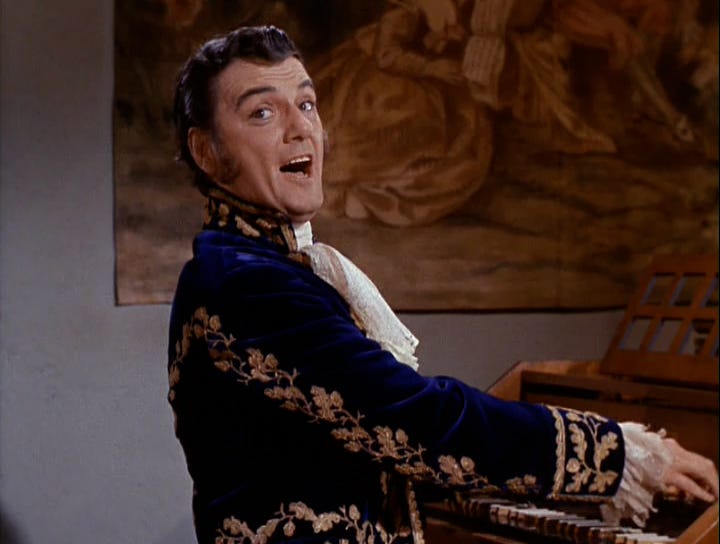
William Campbell’s Trelane is one of the most memorable characters in the series’ history. His performance most likely influenced Gene Roddenberry’s creation of Q.
“Predator Against Predator”
Paul Schneider was the first Star Trek script writer to bring a second episode to the TV screen. His first script, “Balance of Terror,” was the seventh episode in the first season to be produced. His next script, “The Squire of Gothos,” would be the second.
We wrote about Schneider’s relationship with Gene Roddenberry in our Substack column about “Balance of Terror.” As we’ve been discussing, Roddenberry hired free-lance writers to create the early first-season scripts. The writers generally fell into two categories — experienced television writers, or experienced science fiction literature writers.
Schneider fell into the first category, having written free-lance for TV shows going back to the early 1950s. Before Star Trek, his most recent credits included scripts for The Big Valley, Dr. Kildare, Death Valley Days, and a short-lived military melodrama called The Lieutenant — Roddenberry’s previous production.
Marc Cushman’s These Are The Voyages: TOS Season One offers some insight into who came up with this episode’s story idea. “Balance of Terror” was Schneider’s riff on the 1957 film The Enemy Below. The idea of a meddlesome super-being, while quite familiar in science fiction literature, isn’t in Roddenberry’s March 11, 1964 first-draft outline Star Trek Is … Cushman wrote that Schneider viewed the script as “a subtle anti-war story” mocking an incompetent wanting to play soldier — which you might find evocative of current events.1
While it doesn’t appear to have been the kernel for this episode’s story idea, Schneider did borrow from another work to build its climax. The Most Dangerous Game was a short story by Richard Connell first published by Collier’s in 1924. It was adapted into a David O. Selznick film released in 1932. A big-game hunter named Rainsford is hunted himself by a mad Russian count named Zaroff.
The 1932 film version of “The Most Dangerous Game.” Video source: Timeless Classic Movies YouTube channel.
In the Star Trek version, the meddlesome super-being Trelane hunts Captain Kirk for sport. Trelane’s castle and drawing room are very similar to the one in the 1932 film. Zaroff even plays a piano. The most significant difference is that Trelane’s hunt is stopped by his parents, while Rainsford and Zaroff fight to the death.
Producer Bob Justman, responsible for operations and budgets, saw two problems with the early drafts.
One was the cost. With all the early scripts, the writers seemed incapable of grasping the expenses associated with bringing their vision to the screen. Schneider wrote that Trelane should “marbleize” Kirk and Sulu. That would require making full body casts of William Shatner and George Takei. It was whittled down to a green key light immobilizing the actors.
The other problem was a lack of Spock. Star Trek premiered on September 8, 1966. Schneider’s outline was submitted August 11, a month before the show first aired. His first and second draft teleplays were submitted in mid-October. By then, Spock was starting to catch on with the viewing public as a popular character. Justman wrote in a memo to writing producer Gene Coon:2
Our viewing audience seems to like Mister Spock. I feel as though we should give our audience what they like. If they want more of Mister Spock, we should give them more of Mister Spock.
Looking back through the prism of history, we’d all say, “Duh.” But in the fall of 1966, an artist’s vision was altered in the name of ratings. Such is network television, especially in the 1960s.
(The same happened with Happy Days in the mid-1970s. The minor character Fonzie was popular with audiences. Once given the spotlight, the ratings soared and Happy Days became one of the most popular series on network television.)
We’ve discussed in earlier articles how Grace Lee Whitney’s character Janice Rand was erased from various drafts, after she was sexually assaulted during the filming of “Miri” and then released from her contract. “Gothos” was another example. Yeoman Teresa Ross in early drafts was Rand. So add “Gothos” to the list of episodes which might have included Janice, such as “The Galileo Seven,” “Court Martial,” and “Shore Leave.”
In our column about “Shore Leave,” we discussed how Roddenberry rode his motorcycle to the on-location filming in Soledad Canyon to rewrite scripts on-the-fly while the film crew awaited his revisions. Back at Desilu, Coon was polishing the final draft of “Gothos” to get it ready for production.3 That’s how tight the production schedule had become.
As with “Shore Leave,” Roddenberry failed to send “Gothos” to NBC overlord Stan Robertson until it was too late to make any changes. Robertson found Trelane to be “farcical” and didn’t care for the story resolution — Trelane reined in by his parents.4
Production of “Gothos” ran a day over schedule and $9,573 over budget.5
Schneider would write again for Star Trek.
In 2023, Peter Wolchak on his website Collecting Trek published an article about a script titled “Tomorrow the Universe” that Schneider submitted in early 1967, which means Schneider started work on it not long after “Gothos.” You can read the script at this link. According to Wolchak, the script proceeded to a second draft in June 1967, when it was dropped. The premise was eerily similar to “Patterns of Force,” in which a planet’s people decided to emulate Nazi Germany. Schneider filed a complaint with the Writers Guild of America, but the WGA found in favor of Roddenberry.
Schneider returned in 1973 to write “The Terratin Incident” for the animated series.
“General Trelaine. Retired.”
The episode opens with Yeoman Rand, er, Ross serving coffee to the bridge crew. This always irked me, and I’m glad in subsequent series we don’t have servants on the bridge, but the “waitress” is a reflection of its time. At least there’s a cup at Uhura’s station, so it’s not just a girl serving the boys.
The Enterprise is en route to Beta VI to deliver supplies. With “zero space density” (whatever that means) ahead of them, Kirk orders the ship to Warp 3.
Spock and McCoy exchange banter, which I suspect was a contribution by Gene Coon. Around this time, Coon was adding Spock/McCoy banter scenes to scripts to flesh out their relationship. The scenes don’t always advance the story, but they do develop the characters, which will pay off in years to come.
An iron-silica world suddenly appears ahead of them out of nowhere. Navigator DeSalle says it’s “Magnitude 1-E,” which I guess is a fancy way of saying it’s Earth-sized. It’s not a dwarf planet like Pluto; let’s not open that can of worms. In fact, it’s not a planet at all, because a planet has to orbit a star and this one does not. The best term is it’s a rogue planet.
Okay, enough of the astronomy lesson.6
First Sulu then Kirk disappear from the bridge. Spock orders the navigator to hit the brakes. End of teaser.
Act One opens with Spock calling it a planet. Oh well.
Lt. Jaeger replaces Sulu at the helm. In the past, we’ve seen Uhura move to navigation, but I wonder if we’ll ever see her drive. As the series progresses, Uhura becomes chained to Communications and rarely shows other capabilities.
A message appears above Uhura’s console — Greetings and Felicitations. Hip-Hip-Hoorah. Tallyho! Even though the world’s atmosphere is toxic, clearly something lives down there. Spock orders a landing party of DeSalle, Jaegar, and McCoy. Not a redshirt among them. By the way, we haven’t had a crew member killed off since “The Galileo Seven.” The body count for the series-to-date is ten.
The landing party beams down wearing oxygen masks. According to Cushman, an early script draft had them wearing the hideous orange shower-curtain hazmat suits worn in “The Naked Time.” Gene Coon, who wasn’t on staff when it was produced, took one look at that episode and changed this scene to wearing oxygen masks.7
The trio materialize in a glade with breathable atmosphere, but the communicators can’t get a signal out. They find a castle with a large wooden door, which handily is unlocked. They enter without knocking. The room is filled with artifacts from the Desilu prop department. A large mirror mounted above a harpsichord is most prominent.
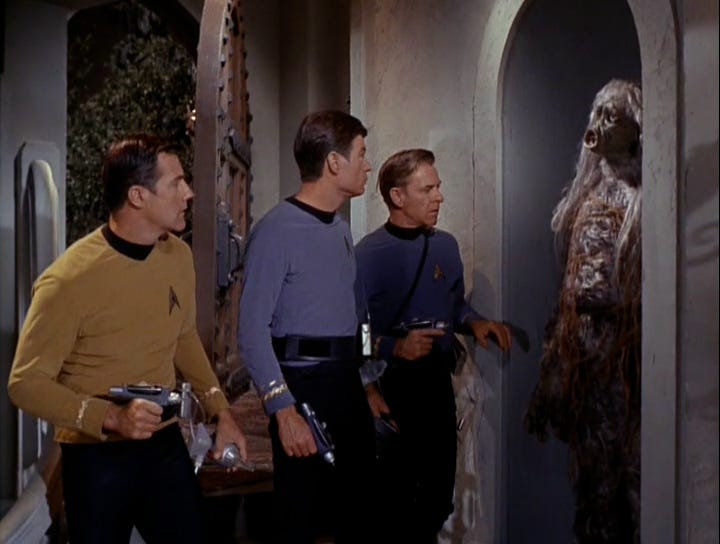
Haven’t we met?
Watch for the Salt Vampire costume from “The Man Trap.” A nice touch is reusing the musical cue played for the creature during that episode.
Kirk and Sulu are found frozen under the green gel light. Out of nowhere, Trelane appears playing at the harpsichord. “I suppose you want them back now,” he says, and with a wave of his hand they’re released from stasis.
Trelane welcomes them to “my stormy little planet of Gothos.” He says that Earth has been his hobby. Jaeger comments on the period discrepancy; they’re 900 light years from Earth, so Trelane somehow has been observing Earth as it was 900 years ago. So far, we’ve had no specifics in any script for when these stories occur. In Roddenberry’s Star Trek Is … he was deliberately vague about the time frame. “It could be 1995 or maybe even 2995.”
Kirk demands to know why they’ve been imprisoned, but Trelane says they’re guests. The squire wants to learn more about Earth history and humans. “Do you know you’re one of the few predator species that preys even on itself?” he observes.
Kirk tells DeSalle to put his phaser on stun. I have to wonder how all this might have gone if Kirk had treated this more like a first contact and simply humored Trelane. Sure, being whisked off your bridge might make you a bit cranky, but misunderstandings are common with first contacts.
Trelane hears the name DeSalle and comments, “I admire your Napoleon very much.” Napoleon Bonaparte lived from 1769 to 1821; if 900 years have passed, then we should be circa the year 2700. Star Trek: The Wrath of Khan will establish that we’re in the 23rd Century, but who’s counting.
When DeSalle tries to stun him, Trelane takes the phaser away. Learning how to set it to kill, he destroys the salt vampire. Has Trelane been to Planet M-113? Did he hunt the endangered salt vampires to near extinction? Just a thought.
Trelane has that he and others of his kind have perfected a system “by which matter can be transferred into energy and back into matter again.” They can not only transport matter but also alter its shape “at will.”
Kirk says they’re going to leave. Trelane comments, “You’re being quite rude.” Frankly I agree with him. This is a first contact situation. “Apparently you need another demonstration of my authority.” Trelane sends Kirk out into the toxic air for a few seconds, then brings him back.
McCoy scans Trelane with a tricorder and reports no reading. Jaeger observes that the fireplace depicts burning logs but gives off no heat. Kirk concludes that the drawing room is a display Trelane replicated from his observations but lacks detail because he hasn’t experienced it.
Having located the landing party on the surface, Spock has them beamed up to the Enterprise. Spock says they beamed up all life forms; since Trelane wasn’t beamed up, he’s not a life form. Trelane appears on the bridge and takes them all back to the drawing room, this time adding Spock, Uhura, and Ross. The food and drink on the dinner table lack any taste. Kirk concludes that Trelane is not “all powerful.” There must be a mechanism.
Kirk reasons that he can strain Trelane into exposing his power source. He slaps Trelane and challenges him to a duel. Trelane opens a box with two dueling pistols. Kirk fires his shot into the mirror, exposing the mechanism. Angered, Trelane disappears.
The landing party beams up. Kirk orders a course maximum speed for Beta VI. Gothos reappears ahead of them, blocking their way, no matter the course correction.
Kirk beams down to confront Trelane, who has created an old English courtroom for trial. Trelane sentences him to death by hanging, but Kirk goads him into upping the stakes — a hunt, on the condition that Trelane frees the Enterprise and its crew. Which he doesn’t.
In the end, two energy beings appear to end the game. Trelane is their child who hasn’t learned restraint or respect. He disappears as he returns to his non-corporeal state. The beings apologize and let Kirk return to the Enterprise.
Is Trelane a Q?
The short answer … no.
The Q continuum didn’t exist in the Star Trek universe until The Next Generation’s pilot episode, “Encounter at Farpoint.”
There’s no evidence that Roddenberry considered Trelane a Q. No Q has ever had a name. They go by Q.
In this episode, Trelane required a mechanism to manifest his powers. No Q needs a machine. They simply will it.
The Q travel time and space as they wish. Trelane needed some sort of device to observe Earth 900 light-years away. His food, his drink, his fire all lacked substance. The Q don’t have that problem.
An April 1987 draft of the “Farpoint” script is on the Internet Archive. Nothing in the script suggests that Q is related to Trelane. The TNG writers guide does not discuss Q.
John DeLancie addresses the Trelane question at a 2019 convention. Video source: BayerDyeman YouTube channel.
John DeLancie has addressed the matter in interviews, one example being an appearance at a 2019 convention. He said he’d never seen the “Gothos” episode until years after filming “Farpoint.” No one, including Roddenberry, discussed Trelane with him before filming. DeLancie’s opinion is that Gene may have wanted a Trelane-like character but that’s as far as it goes.
But that hasn’t stopped others from trying to retcon Trelane into the continuum.
In 1994, Pocket Books published Q-Squared by Peter David. Q seeks Picard’s help in dealing with Trelane, who’s gone renegade.
Trelane returned in the Strange New Worlds episode “Wedding Bell Blues.” Video source: Star Trek YouTube channel.
Strange New Worlds retconned Trelane into the Q continuum, sort of, leaning on a Voyager episode.
In “The Q and the Grey” John DeLancie and Suzie Plakson’s Q characters procreate by simple touch. DeLancie’s character says the Q have never had the need to procreate because they’ve always existed. This contradicts the TNG episode “True Q,” in which Amanda Rogers is the progeny of Q parents executed for using their powers on Earth.
In the SNW episode “Wedding Bell Blues,” Trelane creates an alternate reality where Spock and Chapel are to wed. When Trelane’s father arrives, the voice is John DeLancie’s. SNW executive producer Akiva Goldsman told TV Insider that this episode establishes Trelane as the offspring of the DeLancie and Plakson Qs.
But that doesn’t make it so, to borrow from Jean-Luc Picard.
Marc Cushman, These Are The Voyages: TOS Season One (San Diego: Jacobs/Brown Press, 2013), 432.
Cushman, 434.
Cushman, 436-437.
Cushman, 436.
Cushman, 441.
You may not know that I worked at the Kennedy Space Center Visitor Complex for ten years as a communicator, before retiring in 2021. We’re a combo tour guide / educator / astronaut escort. “Why is Pluto no longer a planet?” came up all the time. Hence my digression.
If you’re interested in learning more about why Pluto is no longer a planet, the American Astronomical Society has this explanation. The short version is that Pluto never should have been called a planet in the first place. It’s one icy ball among thousands of icy balls in the Kuiper Belt. Telescope technology wasn’t able to see the rest of them until the 1990s.
”Rogue planet” as a term first shows up around the year 2000. They’re also called “isolated planetary-mass objects (iPMO)” and “free floating planets (FFP).”
Cushman, 437.