


“The Galileo Seven” script writer Oliver Crawford (right) in July 1955 with stage director James Russo in July 1955. The two were planning a local production for the people of Flint, Michigan. Image source: The Flint Journal via Newspapers.com.
Oliver Kaufman Crawford wouldn’t name names when the House Un-American Activities Committee (HUAC) demanded, so he found himself out of a job.1
Turning 36 on August 17, 1953, Crawford was entering his peak screenwriting years. He’d written a number of teleplays for early television shows, but work largely dried up after his refusal, so he moved back to New York. A July 1955 article in the Flint, Michigan town newspaper reported he was working on the script for an outdoor stage production called the Flintorama Spectacle Show.2
By 1958 Crawford had returned to Hollywood, and was active in the Writers Guild of America’s leadership.3 He was nominated for Emmy awards for episodes of Climax! and Lineup.
Crawford rarely wrote in the science fiction genre, but a script for The Outer Limits won him a Writers Guild award nomination in 1964.4
These credentials brought him to the attention of Gene Roddenberry, who was looking for writers to script Star Trek episodes.
As noted in our last column, Roddenberry had visited the WGA in March 1966 hoping to recruit writers to attend Desilu screenings of the two Star Trek pilots. Several signed up. Barry Trivers, at the time WGA TV-radio branch president, wrote “The Conscience of the King.” Another was Shimon Wincelberg, who wrote “Dagger of the Mind.”
The WGA members played by the rules. Roddenberry did not. He often tried to coax free rewrites out of his free-lance writers in violation of the contracts the studios had signed with the WGA.
In his Star Trek history book, These Are The Voyages, Marc Cushman wrote that Roddenberry turned to Shimon Wincelberg and newly hired script consultant Steven Carabatsos for further rewrites. The final polish was by recently arrived producer Gene Coon.5 The on-screen writing credit was, “Teleplay by Oliver Crawford and S. Bar-David, Story by Oliver Crawford.” S. Bar-David was Wincelberg’s pen name when he didn’t want his real name attached to a script.
According to Cushman, Crawford pitched to Roddenberry a story based on the 1939 film, Five Came Back. It didn’t hurt that the film starred a 28-year old Lucille Ball, who now owned Desilu.
The trailer for the 1939 RKO Radio Pictures film “Five Came Back,” which inspired Oliver Crawford’s premise for “The Galileo Seven.” Video source: Warner Bros. Classics YouTube channel.
The film’s premise is that a commercial airliner flying from Los Angeles to Panama City crash-lands in the Amazon jungle. Although it can be repaired, one engine is kaput, so the plane can carry the weight of only four passengers and a child. The passengers fight among themselves to decide who will survive, and who will remain to be slaughtered by the hostile indigenous people.
Roddenberry liked the idea, but associate producer Bob Justman balked at the potential cost. The script required construction of a space shuttle called Galileo to assume the role of the doomed aircraft. There would be two versions of Galileo — the shuttlecraft set and a miniature to film the space effects.
The show had invented the transporter specifically to avoid the effects cost of landing the Enterprise on an alien world, or even the space version of the wooden launches used during the Age of Sail for explorers (conquerors) to come ashore. Because Desilu declined to fund Galileo, script revisions came to a halt by June.
Until commerce beamed down.
Ten years before George Lucas signed a deal with 20th Century Fox for Star Wars that let him retain all merchandise licensing rights, the Aluminum Model Toys company decided to break the mold, so to speak. AMT would boldly go beyond its niche — selling toy model car kits — to license and produce Star Trek spaceship models. In exchange for the rights to sell Enterprise models (some assembly required), AMT agreed to pay for the design and construction of Galileo.6

The original USS Enterprise starship model kit sold by AMT in 1968. Image source: Memory Foxtrot Wiki.
Some of the correspondence between AMT and Desilu can be found on the CollectorModel.com website. (The documents state the true name of the shuttle is Galileo Seven, which is why its hull number is NCC-1701/7.) An August 2, 1966 letter required the hardware to be delivered disassembled because a union local insisted on assembling it. The target delivery date was September 12.
The Galileo has a long and tortured history. As documented by CollectorModel.com, a collector bought the decrepit shuttlecraft in 2012 for $70,000. It was finally restored and put on display at Space Center Houston in July 2013. The shuttlecraft is now in the possession of the Star Trek Set Tour in Ticonderoga, New York for eventual display.

The AMT-built shuttlecraft exterior as first seen in “The Galileo Seven.”
The 22” miniature was discovered in 1987 at Paramount in storage. The model was restored and appeared in Will Riker’s quarters in The Next Generation first-season episode, “Lonely Among Us.” It’s been loaned out for public display a few times, and appears to still be in the posession of Paramount.
In any case, AMT’s generosity allowed Crawford’s script to be resurrected.
Cushman’s history describes the various incarnations of the script. Crawford submitted his first draft outline on April 1, 1966, just days after Roddenberry’s presentation to the WGA and the Desilu screenings. Cushman notes that it was Kirk who led the landing party, not Spock. The ship’s doctor was still Mark Piper, played by Paul Fix in the second pilot; McCoy had yet to beam aboard.7
According to Cushman, it was Roddenberry who suggested that Spock command the shuttlecraft while Kirk remained aboard the Enterprise. This required a significant rewrite by Crawford. He and the production staff quibbled over which version this was; staff called it a “Revised First Draft” while Crawford’s cover sheet called it a “Final Draft.” Under WGA rules, that meant no more revisions unless production paid for it.
Revisions resumed after AMT stepped forward to fund Galileo, starting with Shimon Wincelberg. His draft added Yeoman Janice Rand to the landing party, but Gene Coon’s final draft replaced her with Yeoman Mears after Grace Lee Whitney’s contract expired. Coon also amplified the bickering between Spock and McCoy, an evolving trope that would soon endear fans to the characters’ ongoing dynamic.
A version of the final draft dated September 15, 1966 is available on the Internet Archive. (It was originally on Roddenberry.com.) Click here to download the PDF. The writing credit is, “Written by: Shimon Wincelberg and Oliver Crawford.”
Filming began on September 22, 1966. Two episodes had aired by then — “The Man Trap” on September 8, and “Charlie X” on September 15. The ratings had been strong, so there was hope for the series’ future. “Where No Man Has Gone Before,” the second pilot, aired the night of the 22nd. I wonder what audiences thought about the sudden wholesale change in the crew complement.
Due to the lengthy post-production, “The Galileo Seven” didn’t air until January 5, 1967. Here’s what viewers saw that night.
The Enterprise is on its way to Makus Three for a rendezvous to deliver medical supplies. Galactic High Commissioner Ferris (no Federation yet) is aboard to oversee delivery and be a general pain in the rear for Captain Kirk.
Hanging in space like a Hot Shot No-Pest Strip is a quasar called Murasaki 312, which Kirk can’t resist. Ferris arrives on the bridge to protest, but Kirk says he has standing orders to investigate quasars, and they have two days to spare. (It’s not like the quasar is going anywhere. Deliver the medicine and come back …)
The miniature version of the Galileo debuts on the miniature flight deck. Cut to its interior, where we see Spock at the controls. Seven crew members are aboard; the only two series regulars are Spock and McCoy. Scotty is also aboard, but James Doohan didn’t have a full-season contract yet. The remaining four are candidates to join our growing casualty list.
(Our last crew casualties were in “What Are Little Girls Made Of?” Our first two redshirts met their demise in that episode, for a total of eight so far in season one.)
The script describes astro-physicist Boma as “a strong Negro” — a sign of the times. The other expendables are Yeoman Mears, Radiation Specialist Gaetano, and Navigator Latimer.
Sure enough, the quasar causes Galileo to lose control and plunge into Murasaki 312. The massive radiation disrupts communications, and the Enterprise is unable to locate them.
There’s your teaser.
Ferris berates Kirk for having strayed from the mission and accuses him of having lost seven crew members. Kirk replies that he has two days. This is a basic writer’s trick — start a clock ticking to create suspense.
Uhura reports that records show the quasar has one habitable planet, Taurus II. It appears that Uhura is acting as first officer in Spock’s absence. In earlier episodes, she’s relieved at navigation. One can understand Nichelle Nichols’ disappointment as her character had less and less to do as the season continued. She almost quit the show.
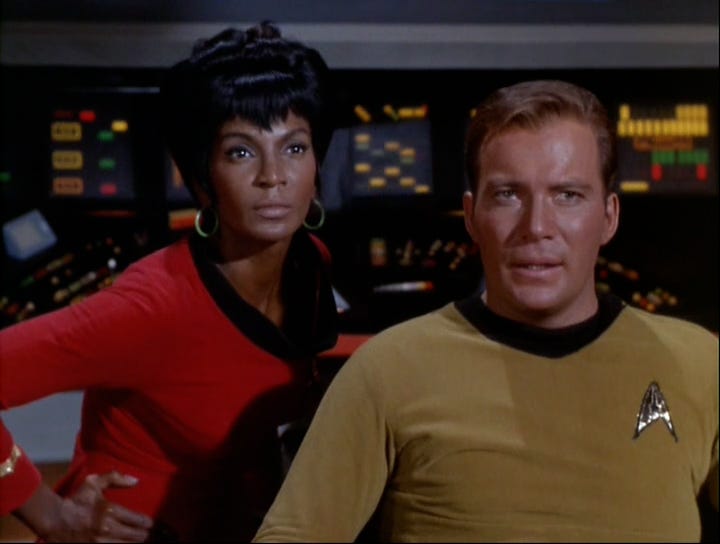
With Spock and Scott off the ship, Uhura apparently is second in command, even though it wasn’t clearly stated.
Galileo has crash-landed on Taurus II. Spock orders Scotty to begin repairs, while the rest of the crew exits to the surface. He tells Latimer and Gaetano to arm themselves with phasers, which we see in a storage bin.
Kirk orders a second shuttlecraft, the Columbus, to scour the planet surface looking for Galileo. We never see a shuttlecraft with that name displayed, but it’s established as canon. If Galileo is NCC-1701/7, what number is Columbus?
In a scene I suspect was written by Gene Coon, McCoy banters with Spock, accusing the Vulcan of relishing the opportunity to command. Spock replies:
I realize that command does have its fascinations, even under circumstances such as these. But I neither enjoy the idea of command, nor am I frightened of it. It simply exists. And I will do whatever logically needs to be done.
This dialogue exchange is critical for how the story resolves itself. It also lays a foundation for the Spock-McCoy relationship that continues for another 25 years. Spock will rely on logic, and McCoy will nag him to push beyond logic.
The script is crafted so that the other crew members are borderline insubordinate to Spock. Only Scotty shows him proper respect. Sure, the conflict creates drama for the audience, but in reality I doubt such behavior would be tolerated.
Scott reports that Galileo has lost so much fuel it will need to drop 500 pounds just to reach orbit. Spock comments that’s equivalent to the weight of three men. McCoy barks that equipment could be tossed instead, but Spock replies there’s very little excess. If three need to stay behind, he will decide using logic.
Out on patrol, Latimer and Gaetano encounter one of the giant natives, who throws a spear into Latimer’s back. Dead crewmember #9. Less weight to worry about. Gaetano and Boma bring the body back to Galileo for burial, which Spock considers a waste of time.
The natives prepare for another assault. The human crew members want to attack, but Spock hopes to frighten the natives into leaving. Spock leads Gaetano and Boma into a display of superiority. After firing off phasers, Spock orders Gaetano to remain behind on guard, confident that his strategy worked.
While Gaetano awaits his fate, Scott proposes draining the phasers for enough fuel to launch, even though they’ll have no defenses. Spock agrees.
Gaetano’s fate arrives. Dead crewmember #10. Spock finds the body and uses a firefighter’s carry to bring him back to Galileo. The Vulcan is quite puzzled that the natives acted so illogically.
With the ion storm clearing, Kirk has ordered landing parties, only to have (off-screen) one crewmember killed (#11) and two injured.
Kirk’s time has run out. Ferris assumes command. He orders Kirk to recall Columbus and the landing parties, then immediately depart for Makus Three. Kirk reluctantly complies.
Galileo launches with enough fuel for one orbit. After that, the shuttle will burn up on re-entry. Spock decides to jettison the fuel, which creates a flare, hoping someone might see them.

Spock jettisons and ignites Galileo’s remaining fuel. This effect was a reason why the episode was one of the most expensive in the series’ history.
Enterprise sensors detect the flare. Kirk orders the ship to reverse course. As Galileo begins to burn up, the Enterprise transporters beam the survivors aboard.
By the time “The Galileo Seven” aired on January 5, 1967, Star Trek’s ratings were in decline. According to Cushman, the show finished third behind CBS and ABC content. The episode cost $232,690 to produce, one of the more expensive in the show’s history.
This did not go unnoticed, by the studio or by the network.
"Television Writer Overcame 1950s Blacklisting,” Los Angeles Times, September 30, 2008, retrieved December 26, 2025.
Rudolph H. Pallotta, “Manual Workers Impress Flintorama Script Writer,” The Flint Journal, July 31, 1955, 61.
"Film Writer’s Candidate Announced,” Los Angeles Citizen-News, February 28, 1958, 2.
"Writer Oliver Crawford Dies at 91,” Variety, September 29, 2008.
Marc Cushman with Susan Osborn, These Are The Voyages: TOS Season One (San Diego: Jacobs/Brown Press, 2013), 346-348.
Cushman, 346. Steve Thomas, “The Shuttlecraft Galileo — Part 1,” StarTrek.com, August 18, 2011.
Cushman, 343.